- Born 17 April 1841, youngest son of Rev. Charles Boileau Elliott (1803-1875) and Emily Dougan (1806-1877).
- Younger brother of Emily Elliott (1839-1924) who mentioned him many times in her memoirs.
- Died in Switzerland on 15 August 1862, of typhoid. He was aged 21.
- Buried at G'Steig, with a memoiral at St. Mary's Church, Tattingstone.
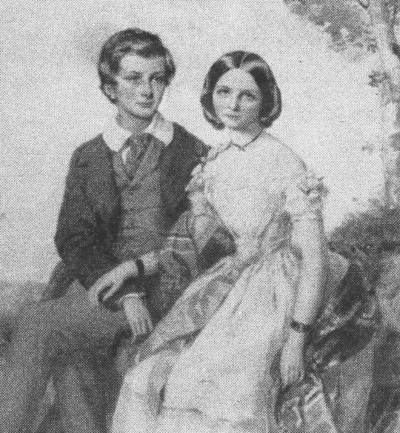
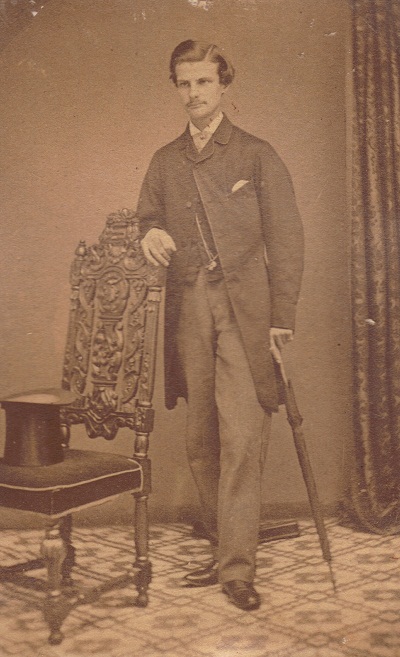
LEFT: Arthur (aged 13) with his sister Emily (aged 15) in ~1854. RIGHT: Arthur as a young man.
Mentions in his sister Emily's Memoir:
"And here [Tattingstone Rectory, Suffolk ], during 3 or 4 quiet years, I and my brother Arthur, and sister Isabel, were born." p11
"My dear Mother's quiet time was nearly over, and my sister Isabel was but a few months old when my Father was off again on his travels, leaving a good Curate in the Rectory. This time there were 6 children to leave. Alicia and Charlie were disposed of among relations, and we four little ones, Willie and I, Arthur and Isabel, found a home at Bromley in Kent with a married Governess, a Mrs. Hewison, a very sweet person, whom we involuntarily called 'mama' for two or three years, knowing no other; and she did indeed act a mother's part to us." p11
"After tea, which I think on Sundays we always had downstairs, we used to form a semicircle round the French window in the Drawing Room and repeat hymns, beginning with the youngest – one of our summer visitors entitled it 'The Sunday Picture'. Sometimes amusingly mal à propos texts would be said - when suddenly asked for one - as when Arthur stood up in a very solemn way and said "There is no fear of God in this house"! Though I remember we all felt much more confused when, during one of Grandpapa's late visits - he far on the way to 80 - Arthur or Isabel stood up and said "The days of man are 3 score years and ten" etc., and then as they sat down made it worse by saying, in an audible whisper, "that wasn't meant for a hit at Grandpapa"! Hymn singing at the piano always ended the day for us – the old melodys by Kelly, being great favourites of ours - 'Sound the loud timbrel' - and 'From Egypt lately come'; and we always concluded with the 'dear and honoured' Great Grandmother's favourite 'Father whate’er of earthly bliss, Thy sovereign will denies - Accepted at the throne of grace, let this petition rise - Give me a calm and thankful heart, From every murmur free - The blessings of Thy grace impart, And make me live to Thee'." pp15-16
"It was now thought well that I should go to School abroad. I was told that I was found unmanageable in the Schoolroom! though our dear old friend Miss Hyde stoutly denied having said so, in later years. One cold October morning I drove away from the old Home with a bright face, and won a character for great pluck because I did not shed a tear! and though that is 36 years ago I can remember as well as if it was yesterday, comforting myself with the thought 'after parting comes meeting'! Life has proved that it is not always thus — but yet that same thought has come back, as a sort of refrain from childhood's days, scores and scores of times to me with solid comfort - and thank God we need not stop short at Meetings in this life. Brussels was decided upon - and our Father took Arthur and me across the Channel to our respective schools. p18
"It was a happy moment when we stopped at St. Catherine's Wharf, and I saw my handsome brother Arthur standing waiting for me; for he was my pair in the family, and I thought him as near perfection as could be. Moreover we had not met for two years. He laughed at my broken English - for I had hardly spoken my mother tongue for 18 mons.; but my dear parents were well pleased that I had accomplished the end for which I had been sent abroad." p20
"My Grandfather died in 1856, and my Father, who was his Executor, had a great deal of business to see to that summer. His fortune was divided between our Father, and our Uncle William Elliott, his only two sons then living; and from this time my Father was very well off. But the last tie that bound him to England was now severed and he resolved to give up his house in England, and live abroad. My parents and Aunt Alicia spent that winter at Naples; I returned to school in London - and your Aunts Isa and Mary sent to school on the Rhine where I had been. The following year, 1857, your Uncle Arthur left Cheltenham, Head of the College, where he had been for 5 years, with all manner of honors and prizes; and we all met our parents for the summer holidays at Spa, Belgium; and enjoyed the novelty of riding the Ardennes ponies which abound there.
In August I returned to school in London - and Arthur entered Addiscombe College for a two years course, preparatory to getting into the Engineer Corps. This time was a crisis in his life; destined to be bright, though short.
The well known agéd Divine, Dr. Marsh, was then living with his family at Beckenham Rectory, in Kent; and his daughter, Catherine Marsh, a woman of great and consecrated powers, was one of the first ladies who braved public opinion, and took up Evangelistic work as a preacher amongst navvies, then engaged in constructing a Railway in North Kent. The account of her remarkable work amongst this fine, albeit rough, race of men, is told in 'English Hearts and Hands' by herself. Her Sunday evening meetings in the "Barn" for these men, was thrown open also to the young Addiscombe cadets - who thought little of the three mile walk when they found such a warm welcome ever ready for them from this dear and excellent family - the Marshs and Chalmers. And here it was that dear Arthur first read his title clear, and full of youthful zeal and fire, set himself to win his bro.sub officers, and cadets for the Lord. His plan was to concentrate prayer on one man until he was converted, and then on another, and when possible to get one in sympathy in the College to join him in prayer.
The story of one, whom I remember myself, is so instructive that I must record it. His name was Charles Baldwin - a very fine fellow - but much opposed to my brother as a 'pi man'; and one of the rowdy drinking set. As this young man was popular among his own party, Arthur felt it was the more important to win him for the Lord. Having prayed for Charles Baldwin some weeks, Arthur at length asked him to go for a walk, hoping for a good opportunity of coming to close quarters. But half of their walk was over, and no way had been made. Arthur said to himself 'I must make the plunge now or never' as they turned their faces towards Addiscombe; and began without any apology 'I have been wanting for some time past to speak to you about your soul, Baldwin'. His companion stopped short in the road and said 'Pray why haven't you spoken sooner then! I have been wretched for a long time, and wishing someone would speak to me.' Met thus half way, the work was easy - for the soil in that soul had been doubtless prepared to receive the good seed by dear Arthur's. prayers. And that young soldier of the Cross stood firmly by his banner throughout his bright career - ended soon after our Arthur's on the burning plains of Southern India as a Royal Engineer.
But to return to Addiscombe days. With Baldwin's help, and the all powerful Arm of Prayer, Arthur now made a great stand against drink, which was a curse to the College; and was able not only to stamp out a great deal of the evil, but always shewed himself the truest friend to every man who wished to start afresh on a better road. The only record of the work then done is in Heaven - for Arthur was (rightly) very reticent on the subject. The most we knew was from finding a little list of some 12 or 15 names on a small paper in his Bible headed 'to be prayed for'; these were the names of his greatest opposers. In the spring of '59 Arthur had measles severely, and was nursed at West Wickham Rectory - 3 miles from Addiscombe - by dear Mrs. Austen in a peaceful and lovely home which was at this time of our lives our haven of rest; for while our parents were abroad, we all spent our holidays there; and Arthur and I had many happy hours, and first learnt to read and pray together in that sweet spot.
In June [1858] Arthur surprised everyone by coming out Head of the College; winning the Sword, given for the highest moral conduct during 2 years; and the 'Pollock Gold Medal' for greatest general proficiency, and largest number of Prizes, despite the serious interruption to his studies caused by his ill health. But grievous disappointment awaited him; for the Medical Board now refused to pass him for India! it was with a strange mixture of feeling that we received a telegram from him saying "India will never see me"! for this verdict which had blighted all his then prospects, spared our brother to us in England. Our Father was very proud of Arthur - and I think nothing loth to keep him in England - so it was decided that he was to read with a tutor for a year, at Rowsley near Matlock in Derbyshire, and enter at Trinity College, Cambridge, in October 1860." pp21-23
"In July we were all there, except our brother Charles who did not come home from India till the following year; and two of Arthur's chief friends were also with us part of the summer. These were our cousin Robert Hawkins (whom Arthur had nursed through a dangerous illness at Addiscombe) and Henry Clarke, now Colonel of R. A. who had just passed out of Addiscombe and was bound shortly for India. How strangely lives cross and recross each other when God means to bring them together you will see later on in this year, when I shall again mention H. S. Clarke. These three friends were very closely united in the Lord - having suffered a good deal for His Sake at Addiscombe.
I remember hearing that our father was much moved at surprising them one day praying together in Arthur's bedroom; for in those days it was not as common as now, for young people to commune thus together of holy things. Sometimes we four girls joined them for a Bible Reading in the Shrubbery, ending with prayer. We had a good deal of music together too; as amongst us we had all the parts required - Arthur and H. S. Clarke took bass; Robert Hawkins tenor - Aunt Alicia and Isa altos – Aunt Mary and I sopranos. We got up many beautiful glees - and sacred quartettes and trios. Sterndale Bennett's "May Queen" - "As pants the hart" (Spohr) Trios of Haydn's - Mendelssohn's "Lift thine eyes" - and a quartette by Waley was a great favorite, "This world is all a fleeting show".
Dear Miss Marsh came down during this summer, and addressed, a large gathering of our poor people on the lawn. She gave away many of her delightful little books - and quite recently I found one of these on a shelf in a cottage at Tattingstone. Our dearest Mother, who now met Miss Marsh for the first time, thanked her warmly for all the help she had been to our Arthur - to which that great soulwinner replied "Don't thank me, my dear Mrs.Elliott! I was only the poker who stirred the fire that you had laid by long years of prayers." Words of noble disinterestedness - and of undoubted truth. How encouraging to every praying Mother!" pp26-27
"I was very happy these nine months; and never felt the least dull, though living alone with two elderly people. I undertook a little parish work; and learnt to illuminate texts, and many other things from this dearly loved 'Granny' as we called Mrs. Austen. Mary, now at school in London, always spent her holidays with us; and Arthur also joined us sometimes, until the summer of '61, when Charlie returned from India on furlough; and we four went out to meet our Parents, Alicia and Isa at Interlaken.
When we broke up our home at Tattingstone in October 1860, Arthur went up to Trinity College, Cambridge, and our great uncle Henry Venn Elliott undertook to introduce him, with his own son Julius, to friends there.
One morning they breakfasted at a Mr.Gell's rooms, Fellow of Christ's Coll. and Arthur was introduced to a young man, just ordained, and about to sail (on the 20th) from Southampton to India, for Mission work. As that young man, who was one day to be your Father - and my brother looked each other in the face, they knew that they were kindred spirits. I see that 'Father' has on pages 67 and 68 of his 'Story' written at some length about that meeting, so I will not repeat; and only mention what he has not done!
That, at your Father's request, Arthur undertook the Secretaryship of the Church Missionary Union, and worked it well for the two years of University life granted to him. And further, that Arthur gave your Father a letter of introduction to his dear friend, Henry Clarke, who was sailing in the same ship for India, feeling sure they would be friends. He thought rightly - and that voyage was a most happy one for both the young men; and a time of blessing to many who sailed with them.
The summer of 1861, as already mentioned, was spent by us all eight at Interlaken. My brother Charles had come home to look for a wife! and was very droll about the unlikelihood of his success! As Arthur had more address, and more conversation than he, Charles took a pride in extolling the younger brother's superior attractions! and with real and naive humility used to push Arthur forward to make friends for him saying that he would try and make a good impression later on the strength of Arthur's charms! However, when it came to the point the following year, as usually happens, Charles chose for himself and married your Aunt Fannie - a Miss Lister - in May 1862.
In September 1861 the two brothers went for a short walking tour to the Italian Lakes (I think); and 'Aunt Isa' went into a Swiss family at Clarens (at Basset Barrilliet) for a year; and Mary to school at Geneva, the opposite end of the Lake. It was one of my father's strange fancies, not to have more than two daughters at home at once; and another was not to let sisters be at school together, if possible. I do not think the two sisters, though so near each other, met once during the year! On leaving Interlaken, our parents, Aunt Alicia and I went through the beautiful valley of the Simmenthal to Geneva; spending three weeks at the lovely Chalet hotel 'Rossiniere'; and so to Nice for the winter of 1861-62." pp28-29
"Very briefly - our Father's conduct to us all had been so much talked about by this time outside the family, that our Great Uncle Henry Venn Elliott thought right to interfere on our behalf. My father resented this exceedingly, and little good resulted. It came out that during my stay in England, Arthur and I had both been questioned by the uncle, and being no longer children, had not kept silence. The chief brunt of my Father's displeasure fell of course on me, as present, and I was more than willing to bear Arthur's share.
How many dark, dark days there were that winter! We never expected sunshine, and were thankful to get through a day without a storm. My Father saw but one way out of the difficulty of keeping any longer at home one who had offended as I had done; and this was to send me to India with Uncle Charlie in the coming autumn. But - for the sake of appearances, I must be supposed by the family to have elected to go, myself. So, having told me how desirable he thought it that I should accept Charles's invitation, he said that if I went, I should carry with me his blessing - but if not ........ And thus it was left to me to 'choose' - and I was to give in my decision on a certain day.
A text book I used at the time helped to assure me that my decision to leave home was a right one. For on opening it on January 20th (1862), the day fixed by my father, these words met my eyes: "Thine ears shall hear a voice behind thee saying 'This is the way, walk ye in it' (Isa.30.21)". So I told my Father that I thought I should be right to go under the circumstances, and the matter was settled; though none but my Mother and Aunt Alicia knew what it cost me to leave them, and (as I then thought) the dearly beloved Arthur.
From this time forth I was, so to speak, 'whitewashed', and arrangements were made that I was to have everything of the best for my outfit, most of which was obtained from England. The greatest pleasure of this winter was our friendship with the Reverend Charles Childers' family, at Nice. His sweet wife and daughters were almost the only friends we were allowed. We went out a good deal to formal musical evening parties - but were never allowed to sit long beside anyone. Our dear Mother, whose talent for sketching both with pencil and brush I have, I think, hardly mentioned, used sometimes to go out with her block and paints - and sitting down on a camp stool in an olive grove, or orange garden, or on a hill side, forget all home trouble while transmitting to paper the beauty of the scene around us. I was always her companion at these times and found out many years later, when I painted a few flowers for your Father, how very much I had learnt from watching her use of colour at these times. As summer approached, we paid short visits to both Menton and Cannes - then very small and rural places unspoiled by a great influx of strangers, as now.
On leaving Nice we spent a month at Vichy in France and then once more made our way to Interlaken, where for the last time we met as an unbroken family, in July. Arthur joined us from England - Aunts Isa and Mary from Switzerland; and later, Uncle Charlie and his bride. How little we thought that, ere the autumn took three of our party to India, one of our number would be called 'to go up higher'.
We were, all struck with Uncle Arthur's delicate looks - and on the 15th July, after getting wet through on a steamer on Lake of Brientz, returning from a day at the Giesbach, he began visibly to fail. He seemed to lose all strength and appetite - and to be gradually consumed by a low fever. Everything was an effort - and one thing after another was given up. During the hot part of the day we used all to sit down by the river side under a clump of walnut trees - and read aloud and work. Gradually Arthur became too weak to walk down, and kind friends wheeled him there for a few days; soon even this became too much for his gradually waning strength - and he ceased to join us. Then he could not come in to meals, and used to lie on a sofa outside where he could get air, during out Table d'hote. On one such occasion we heard afterwards that he said to a lady friend who was keeping him company (alluding to the quartette by Mendelssohn which we often sang together) "I often long for the wings of a dove to fly away and be at rest - for I am so weary."
About August 1 [1862] our parents felt so anxious about the dearest Brother, that a Swiss doctor was called in - who failed to see the serious character of his disease, and treated him wrongly. Later on an excellent American, Dr. Bolton, came to our hotel, and immediately threw his whole strength into the case, seeing how serious it was - and what a beautiful life was fading away. He pronounced the fever to be typhoid - and used every human means to bring our dear one through. But God willed otherwise ... Meanwhile we were being taught to live without him - and only one of us at a time was ever with him - either sitting near, while he slept, or reading to him.
Our Mother seemed to have special strength given her for those two weeks of incessant nursing - for I never remember her either before or after that time able to do so much. On August 12th [1862] Charlie and Fannie had to leave us, for England; and I know he realized that he might never see Arthur again - for he said with faltering voice after wishing Arthur goodbye 'remember if anything happens to Arthur I should value his Bible.' Next morning at 6 o'clock Dr. Bolton told our parents he had no longer any hope of our dear one's life being spared; and our brave Mother knelt by his side to tell him so. He answered directly with a bright smile: "Well - to depart and be with Christ is better - far better!"
Throughout the day he repeatedly took his pocket Bible, Miss Marsh's gift, and read portions aloud to us - such as Rev. XXII, Phil. III, and passing over Eph. VI said "the work is all over now." To our dear Mother he said "You did not think I should be first! But I'll be at the gate to welcome you, my Mother." Canon Hugh Stowell who happened to be in the Hotel, came up for a few minutes, and prayed with him, and on leaving said 'Would that all in this Hotel could see how a young Christian can die!' We encouraged him to sleep a good deal, and once after a cup of broth when I was settling him comfortably for a doze, he turned and looked earnestly at me and said: "Darling - if I should go to sleep, and never wake again, you'll know that I have gone straight to Jesus! What a quiet passing away that would be, and what a glorious awakening to find myself with Him." And then he closed his eyes, and fell asleep evidently thinking he should never wake again.
Our Father, knowing that Miss Marsh would wish to hear of it, telegraphed to her 'Pray for Arthur's departing spirit - he is conscious - all is peace.' The answer came back "Tell him Jesus says 'because I live, ye shall live also' - nothing can separate us from the love of Christ. Tell him how we love him, and shall meet him." (This incident is mentioned by her in her life of her father - the well known Divine Dr. Marsh D.D.).
During the two following days life ebbed fast; and he wandered much - though the incessant talking was always on flowers, or on children or on the longing to be up again, and on the mountain side, which never left him. He had asked us when he felt himself getting ill to pray that if he should be delirious no word should escape him concerning the late troubles in the family - and this prayer was fully answered.
Twice at different times, when our father tried to see if he were still conscious, by asking if he knew different members of the family, he failed to respond in every case, until asked 'you know Jesus don't you? ', then he turned his head on the pillow, and the dear eyes from which the light of earth was fading fast, seemed to reflect a far more glorious light beyond as he said "Oh yes, I know Him! He loves me - I love Him." Every hour of the 14th we expected he would breathe his last - but he had still one last word to speak for his Lord. During that night when he had for some hours seemed unconscious, and the Swiss nurse alone happened to be in the room, one more flicker of life and consciousness seemed given him - and looking round the room he called her - and thanked her in broken French for all her goodness to him. She replied 'Mais, Monsieur, c'est vous qui etes si bon si gentil!'; to which he replied "Non - non - je suis un pauvre misérable pécheur, mais pour l'amour de Jésu Christ jé serai sauvé! Et le sang de Jésu nous nettoyé de tout péché." ["No, no, I am a miserable poor fisherman but with the love of Jesus Christ I will be saved! And the blood of Jesus cleans us of all sins."] And thus with his last words, a wish of years was fulfilled, and he was permitted to preach his first (and only) sermon from 1 John I.7.
A few hours later, as the sun rose behind the Jungfrau, [[@http://en.wikipedia.org/wiki/Mönch|Mönch]] and Eiger mountains who clad in their eternal snows looked like majestic sentinels watching that hallowed room, angels carried the blesséd spirit of our Arthur to be 'for ever with the Lord' - and the chiselled marble features lay peacefully on the pillow - with a smile on his lips.
Swiss authorities require that burial should take place in 24 hours. When laid in his coffin, we covered our dear one with fresh flowers - especially heartsease - and the following day, August 16 [1862], a low charette, covered with flowers drawn by one horse, and led by one man, carried him to the sweet village churchyard of G'Steig, a mile out of Interlaken, - we sisters all four following in white, and a few other sympathising friends from the Hotel joining us there.
Canon Stowell repeated our glorious Church of England service by heart I remember, in the little Lutheran Church; and then they carried him through the long pass, and laid him on the hill side where he had longed to be, and whence there will one day be a glorious resurrection unto eternal life.
Within a month, a marble and granite stone engraved at Thun, marked the spot - which is in the left hand corner near a great walnut tree; and I think after this little record of the bright and blesséd death of their young Uncle of 22 years none of my children would go to Interlaken without visiting this, to us, so sacred spot. If you do so, you will recognize on the slab the device on the onyx ring he always wore, and gave me when dying; viz a cross, encircled with the words 'Ye are complete in Him'. A year or two ago your Aunt Mary on visiting the spot had a German rendering of his favorite text 1 John I.7 added to the inscription - so that he 'being dead, yet speaketh' to the people of the country amongst whom he rests. 'Until the day dawn, and the shadows flee away.'
I have lingered long over the first great sorrow of my life, and you who are young will find it perhaps hard to believe that these memories are still so fresh even after 28 years. Did we wish him back again? No - not for an hour, I can honestly say; for was he not "Gone to see the King in his beauty!" Though we ... seemed left far behind him - and life looked long, and sorrow looked endless then." pp29-34
Memorial
My parents visited G'Steig in 2011 and looked for his grave but could not find it.
There is a memorial at St. Mary's Church, Tattingstone:
[[image:St Marys Tattingstone monuments/St Marys Tattingstone monument to Arthur Wilmot Elliott.jpg width="663" height="1003"]]
Image courtesy of Charles Sale, [[@http://www.gravestonephotos.com/public/gravedetails.php?available=yes&fullname=Arthur Wilmot Elliott&grave=13638&personid=20615|www.gravestonephotos.com]].
SACRED TO THE MEMORY OF ARTHUR WILMOT ELLIOTT, YOUNGEST SON OF THE REV. CHARLES BOILEAU ELLIOTT M.A. F.R.S. RECTOR OF THIS PARISH, WHO FEEL ASLEEP IN JESUS AT INTERLAKEN IN SWITZERLAND, ON THE 15TH AUGUST 1862, AGED 22 YEARS.
"WHEN THE FRUIT IS BROUGHT FORTH, IMMEDIATELY HE PUTTETH IN THE SICKLE, BECAUSE THE HARVEST IS COME." ST. MARK IV, 29.